
How to charge portable charger on plane is mostly about two things: what the airline allows, and what power sources you realistically have in your seat.
If you have ever boarded with 10% left on your phone and a power bank that is also nearly empty, you already know the stress point, you want to top it up in the air, but you do not want to break a rule or waste time with a port that barely works.
This guide walks through what usually works on U.S. carriers, how to read the labels airlines care about, and a few practical setups that keep your devices powered without drawing unwanted attention from crew or security.
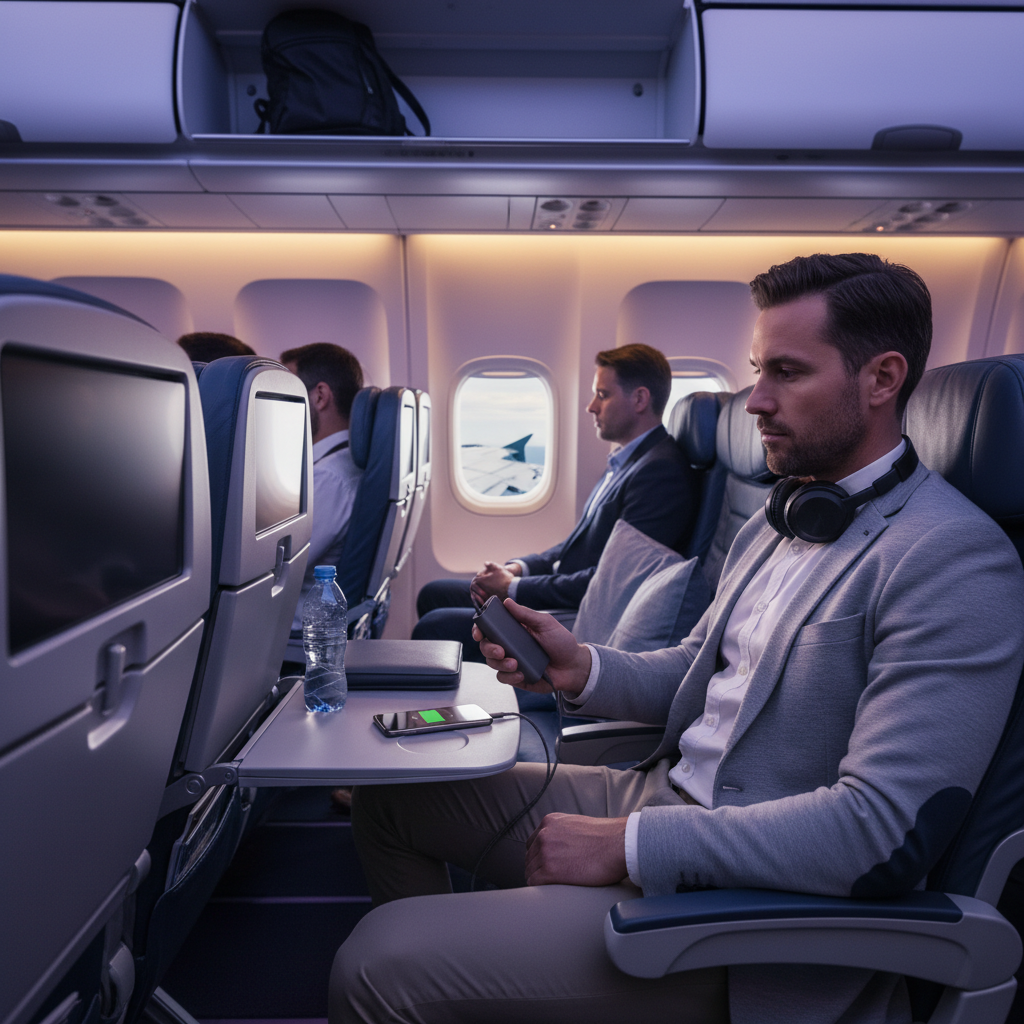
What airlines and TSA actually care about
In the U.S., the bigger hurdle is not whether you can plug in, it is whether you can bring the portable charger at all, and whether the battery rating is within limits.
According to TSA guidance on batteries, spare lithium batteries and power banks are generally allowed in carry-on bags and are typically not allowed in checked luggage. Airlines can add their own restrictions on top of that.
- Carry-on only: pack your portable charger in your personal item or carry-on, not your checked bag.
- Capacity matters: airlines look for the rating in Wh (watt-hours) or sometimes mAh plus voltage.
- Damaged or swollen: if it looks unsafe, expect it to be refused.
- Using it on board: usually allowed, but the crew can ask you to stop if something overheats or if outlet use conflicts with safety instructions.
If your battery does not show a clear label, that is one of the most common reasons people get stuck at screening, even when the size is reasonable.
Can you charge a portable charger on a plane? The realistic answer
Yes, many times you can, but it depends on the aircraft and seat. Some planes have AC outlets, some have USB ports, some have neither, and some have ports that barely deliver power.
Here is the practical rule: if you have only USB seat power, topping up a large power bank might be slow enough that it feels like it is not working. That does not mean it is forbidden, it means you need to set expectations.
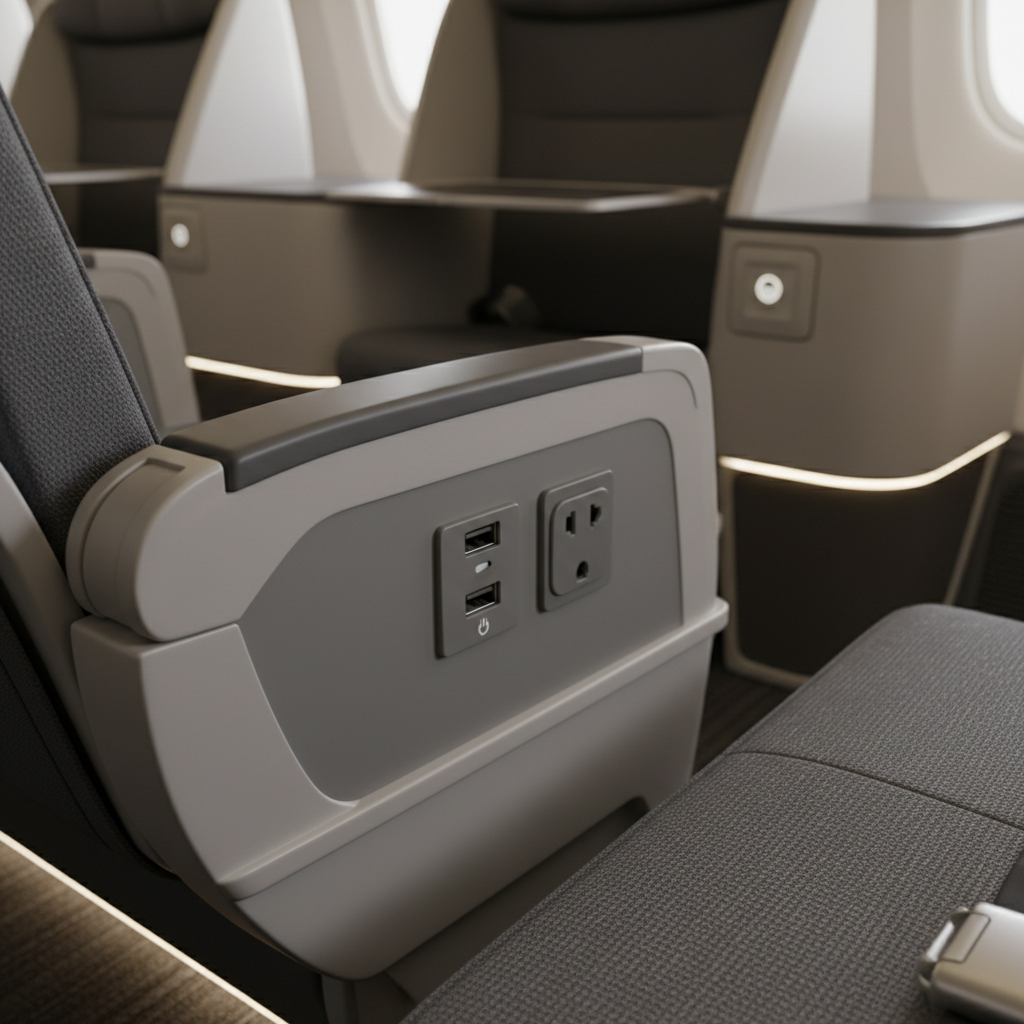
Quick self-check: which situation are you in?
Before you plan how to charge portable charger on plane, take 20 seconds and sort yourself into a bucket. It saves a lot of fiddling later.
- You have an AC outlet at the seat: best case, you can use your bank’s wall-style input or a higher-power USB-C charger if airline rules allow it.
- You only have USB-A: it can work, but it is often 5W to 12W, so large banks recharge slowly.
- You have USB-C in-seat: better odds of meaningful charging, but still varies widely by aircraft.
- No power at the seat: your bank is the source, not the thing you recharge.
- Your bank has pass-through charging: you might charge your phone and the bank together, but heat management matters.
If you do not know what your seat offers, many airline apps and seat maps show power availability, but treat it as “usually” rather than guaranteed.
Step-by-step: how to charge your portable charger in flight
1) If your seat has an AC outlet
This is the simplest route. Plug the portable charger into the outlet using the cable the bank expects, then keep it where you can see it.
- Use a short, good-quality cable to reduce loose connections.
- Do not wedge the bank into the seat gap where it can get crushed or overheated.
- If the outlet feels loose, gently support the plug, repeated sparking or heat is a stop sign.
2) If your seat has USB power
USB works fine for small and mid-size banks, but patience helps. If the bank supports USB-C input and your seat has USB-C, use that.
- Confirm the bank shows an input rating, not just output.
- Avoid running the cable across the aisle or where a cart can snag it.
- If charging keeps cutting out, try flipping the cable end or switching ports, some seat modules are worn.
3) If you want to charge devices and the bank at the same time
Some banks support pass-through charging, meaning they can accept power while also outputting power. It is convenient, but on a plane it can add heat and cable clutter.
- Keep the bank on the tray table, not under a blanket or pillow.
- If it gets noticeably warm, pause and let it cool.
- If the bank manual says pass-through is not supported, skip this approach.
According to FAA consumer guidance on portable electronic devices and lithium batteries, overheating, damage, or unusual behavior is a reason to stop using a battery device and notify the crew.
Capacity limits and labeling: a simple table you can use
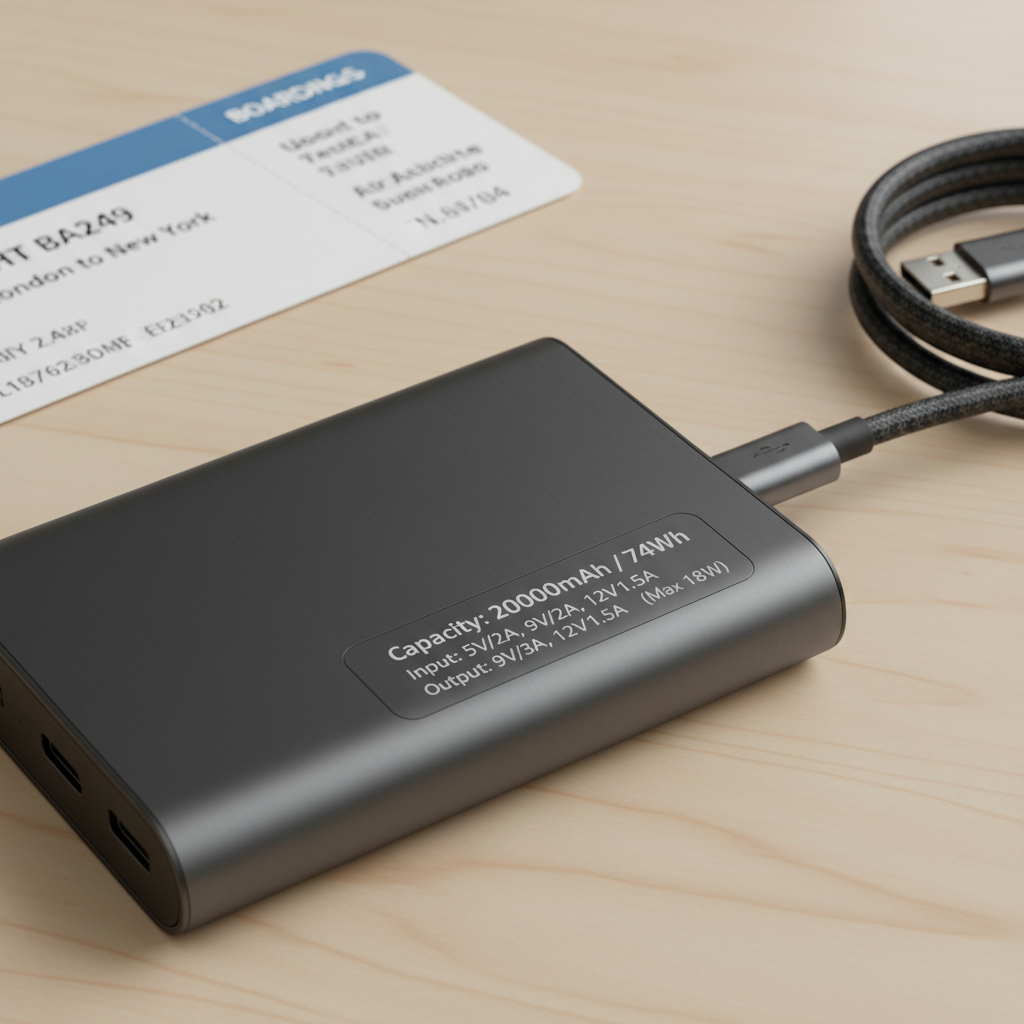
If you are unsure whether your power bank is “too big,” the most useful number is watt-hours. Many power banks only show mAh, so you may need to convert.
Wh = (mAh × V) ÷ 1000. Many banks use 3.7V nominal cells internally, but the label is what matters most at screening.
| What you see on the power bank | What it means for flying (typical U.S. approach) | What to do |
|---|---|---|
| Wh clearly printed (e.g., 74Wh) | Easy for staff to verify | Carry-on, keep it accessible |
| mAh only (e.g., 20,000mAh) | May require interpretation | Bring packaging/spec sheet if available, or know the Wh conversion |
| No rating, faded label | Higher chance of being flagged | Consider replacing, or expect extra questions |
| Swollen, cracked, or recalled model | Safety concern | Do not bring it, replace before travel |
Common mistakes that waste time or trigger safety concerns
A lot of in-flight charging frustration comes from small, avoidable issues, not from strict rules.
- Assuming the seat USB will fast-charge a large bank: many ports are meant for phones, not for refilling big batteries.
- Using a beat-up cable: intermittent contact makes the bank restart charging over and over.
- Hiding the bank: covering a charging lithium battery under a jacket is a bad idea, heat has nowhere to go.
- Overloading outlets: power strips and multi-plug adapters can violate airline policy, even when they “fit.”
- Charging during taxi/takeoff when told not to: crew instructions override convenience.
If your bank ever smells odd, swells, or becomes too hot to comfortably touch, stop charging and ask a flight attendant what to do next. In battery safety, caution beats trying to “push through.”
Practical setups that work well for U.S. travelers
If you fly a few times a year, a simple kit prevents most problems and makes how to charge portable charger on plane a non-issue.
- One short USB-C cable (even if your phone is Lightning, many banks take USB-C input).
- One backup cable in case the first fails mid-trip.
- A compact wall charger for the airport: airports usually recharge your bank faster than seat USB.
- A smaller “flight bank” if you only need emergency power, it recharges quicker from weak ports.
My editorial take: if you consistently need to refill the bank on board, the real fix is often pre-charging it at the gate, in-flight power is helpful but not something I would bet my whole workday on.
When to ask for help or stop using the battery
Most people never run into an issue, but lithium batteries deserve respect.
- If the device shows swelling, hissing, smoke, or a burning smell, stop use and notify the crew.
- If you have a medical device that relies on battery power, it may be worth asking your clinician and the airline about your specific setup.
- If security questions your battery rating and you cannot verify it, be prepared to leave it behind, arguing rarely helps.
Conclusion: the simplest way to avoid a dead power bank mid-flight
Charging a portable charger on a plane is usually allowed when the bank is in your carry-on and the capacity label is clear, but whether it charges fast enough depends on the seat power you get that day.
If you want the cleanest routine, charge the bank to full before boarding, carry one reliable short cable, and treat in-flight charging as a bonus rather than your only plan.
Key takeaways
- Carry-on only is the norm for power banks in the U.S.
- Seat USB can charge a bank, but it may be slow, especially for large capacities.
- Clear Wh labeling reduces hassle at screening.
- Heat, damage, and weird behavior are reasons to stop and ask the crew.
FAQ
Can I charge my power bank using the airplane USB port?
Often yes, if the port supplies power and your bank accepts USB input, but many in-seat USB ports are low wattage, so the recharge pace can feel sluggish on bigger models.
Is it allowed to plug a portable charger into the seat outlet?
Many flights allow it when an AC outlet is available, though airlines can restrict certain adapters. Keep the battery visible and follow any crew instructions during taxi, takeoff, and landing.
What if my power bank only shows mAh and not Wh?
You can estimate Wh using mAh and voltage, but screening staff may still prefer a clear label. If you travel frequently, choosing a bank with Wh printed can reduce friction.
Why does my power bank stop charging after a few minutes on the plane?
Common causes include a loose seat port, a worn cable, or a bank that draws more power than the port can provide. Switching cables or using USB-C when available solves many cases.
Can I charge my phone and my portable charger at the same time in flight?
Only if your bank supports pass-through charging. It can add heat, so keep the bank uncovered and stop if it gets unusually warm.
Do I need to tell TSA or the airline that I have a power bank?
Usually no, but you should keep it in your carry-on and be ready to show the capacity label if asked. Separate screening requests can vary by airport and situation.
What is the safest place to put a charging power bank during the flight?
Somewhere you can see it and it can breathe, like on the tray table or in the seat pocket if cables are not strained. Avoid burying it in bedding or under other bags.
If you are trying to keep a phone, earbuds, and laptop alive on a long trip, it may help to map your charging plan before you board, what charges at the gate, what runs off the bank in the air, and what can wait until landing, that small planning step removes most of the anxiety.